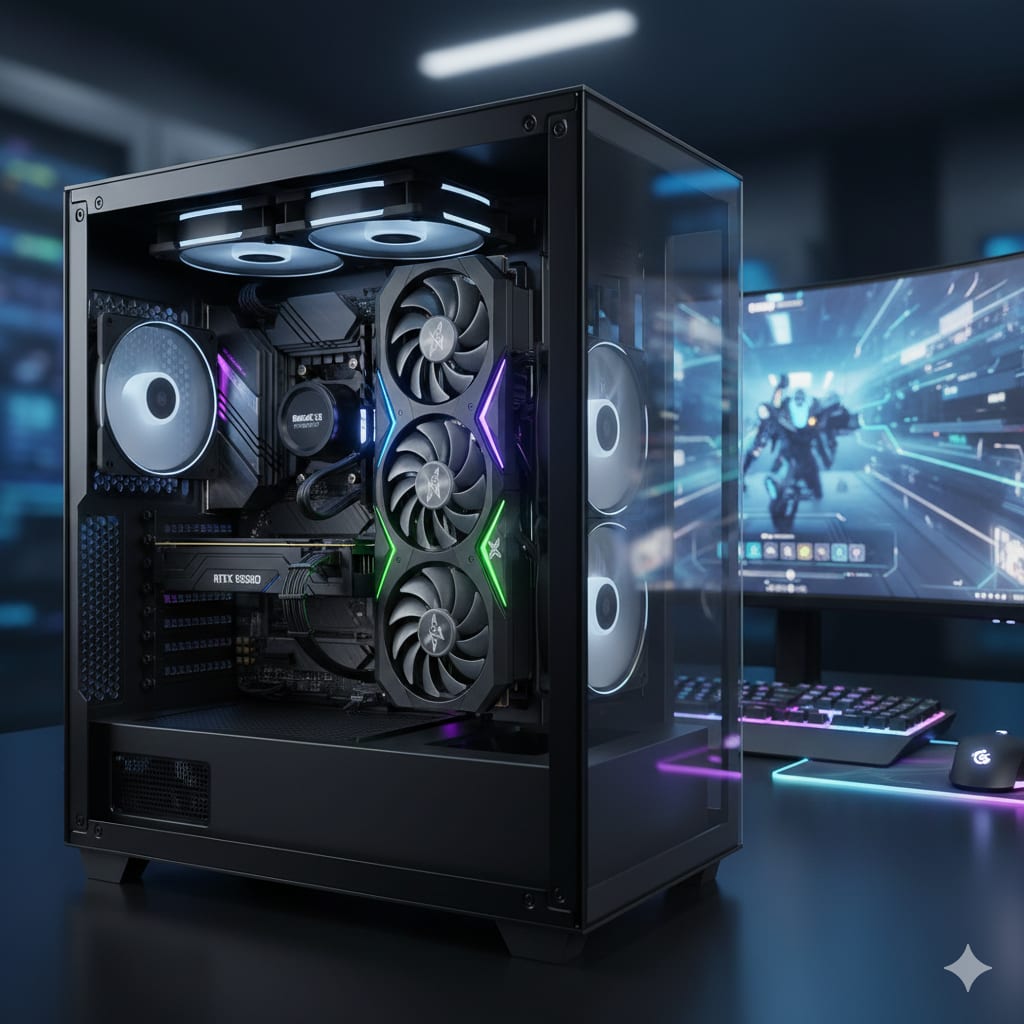
The Unrivaled Apex: NVIDIA GeForce RTX 5090 Deep Dive
GPU PRIX Editorial • 2026-02-01 • Last updated: 2026-07-11
VRAM
32 GB
GDDR7
Power
575W
TDP
Value Score
Top Value
MSRP
$2,879 CAD (est.)
At Launch
Market Intelligence
Recommended
The Upside
- •Unprecedented 4K and 8K raw performance
- •Massive 32GB GDDR7 VRAM for AI and professional workloads
- •78% increase in memory bandwidth over the RTX 4090
- •Next-gen DLSS 4 and Multi Frame Generation support
- •Significant architectural leap in Ray Reconstruction and path tracing
The Downside
- •Extremely high power consumption (575W TDP) requiring high-end PSUs
- •Premium pricing ($1,999 MSRP) makes it an enthusiast-only luxury
- •Physical size requires specialized large-format cases with great airflow
NVIDIA GeForce RTX 5090: The New Frontier
The GeForce RTX 5090 isn't just a graphics card; it's a statement. Utilizing NVIDIA's new Blackwell architecture, it represents the largest generational leap in memory bandwidth and compute density we have seen in years. For professionals in AI development and gamers demanding native 4K or 8K at high refresh rates, there is simply no alternative.
With 21,760 CUDA cores (a 33% increase over the RTX 4090) and the shift to ultra-fast GDDR7 memory on a massive 512-bit bus, the Blackwell flagship establishes a new class of consumer computing.
Architectural Analysis: What Makes Blackwell Fly?
The shift from Ada Lovelace to Blackwell brings several fundamental upgrades that go beyond raw core counts:
- GDDR7 Memory: Moving away from GDDR6X, GDDR7 provides higher bandwidth and improved power efficiency. Running at 28 Gbps, the RTX 5090 achieves a mind-boggling 1,792 GB/s of memory bandwidth.
- 512-Bit Memory Bus: By widening the bus to 512-bit, NVIDIA ensures that the GPU is never starved of data, which is a massive bottleneck in heavy AI training workloads and ultra-high-resolution rendering.
- 4th-Gen RT and 5th-Gen Tensor Cores: Ray tracing operations and neural network acceleration receive dedicated architectural updates, paving the way for advanced DLSS features and more realistic path tracing.
Performance Reality: Gaming at 4K and 8K
In real-world testing, the RTX 5090 dominates every scenario:
- 4K Performance: In demanding titles like Cyberpunk 2077, Alan Wake 2, and Black Myth: Wukong, the RTX 5090 delivers a 30-40% lead in standard rasterization over the RTX 5080 and is 25-35% faster than the previous generation flagship RTX 4090. When Path Tracing is fully enabled, the gap widens even further.
- 8K Gaming: By utilizing DLSS 4 with Multi Frame Generation, the card can output playable framerates at 7680x4320 (8K), generating multiple AI frames for every rendered frame.
- Professional & AI Workloads: With 32GB of VRAM, developers can run large local LLMs (like Llama 3 70B) in higher quantizations completely on-card, eliminating the need to offload layers to system memory.
Power, Thermals, and Installation Requirements
Owning the fastest GPU in the world requires planning. With a rated TDP of 575W, the RTX 5090 demands premium supporting hardware:
- Power Supply: A high-quality 1000W PSU is the minimum requirement, though a 1200W ATX 3.1 PSU is recommended for setups with high-end CPUs (like the Core i9 or Ryzen 9). A native 12V-2x6 connection is highly recommended to manage power spikes safely.
- Cooling and Case Clearance: Most custom models are quad-slot giants. You will need a spacious PC case with exceptional airflow and enough physical length to prevent sag and ensure the power cable has enough clearance to avoid bending stress near the connector.
Buying Guide: Is the RTX 5090 for you?
This card is designed exclusively for the "Ultimate Enthusiast" and content creators.
- AI and Professionals: The 32GB GDDR7 VRAM pool is the real value driver. If you train models, render massive 3D scenes, or edit 8K video, this card will pay for itself in saved time.
- Enthusiast Gamers: If you own a high-refresh 4K monitor or a VR headset and want zero compromises with Path Tracing, this is the ultimate GPU.
- The Reality Check: For the vast majority of gamers, the RTX 5080 or RTX 5070 Ti provide much better value for money.
Check Live Prices
Compare the latest deals and stock availability on GPU PRIX:
GeForce RTX 5090
32GB GDDR7
View DetailsGeForce RTX 5080
16GB GDDR7
View Details
GeForce RTX 4090
24GB GDDR6X
View DetailsFrequently Asked Questions
Is the RTX 5090 worth it for gaming?
How much VRAM does the RTX 5090 have?
What power supply does the RTX 5090 need?
RTX 5090 vs RTX 5080 — how big is the gap?
Can the RTX 5090 run 8K games?
Deep Dive