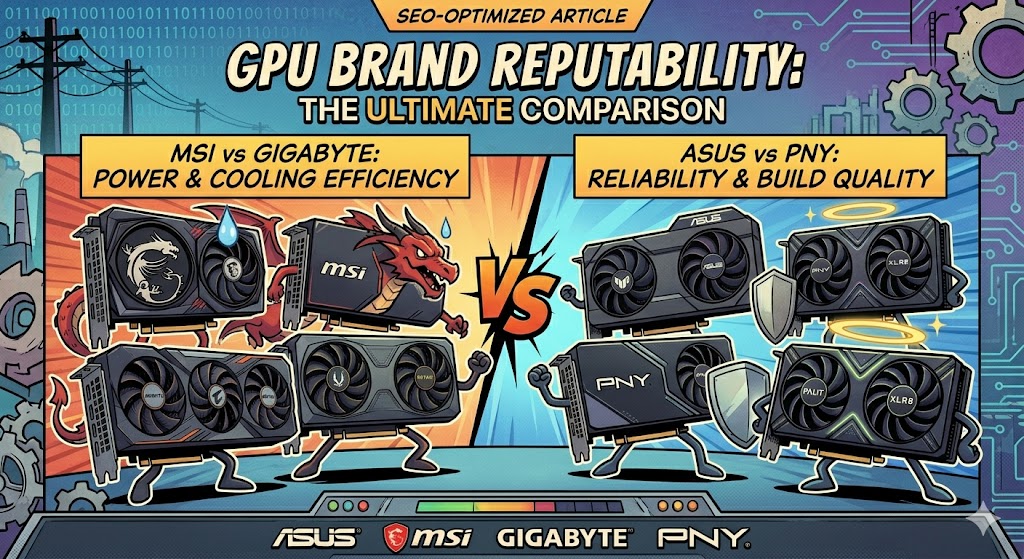
GPU Brand Reliability Guide: What the Data Really Says
GPU PRIX Editorial • 2026-06-13
Does the GPU Brand Actually Matter?
Ever stood in front of two nearly identical graphics cards and wondered whether the brand on the shroud is worth paying extra for — or whether you should just grab the cheapest one and move on?
If you scroll hardware forums looking for an answer, you'll find chaos. Every manufacturer is simultaneously "the best thing ever" and "a complete scam," depending on whatever anecdotal nightmare a user just lived through. Buying a graphics card starts to feel like walking through an opinion minefield.
So we did what forums can't: we looked past the drama and at the numbers. European retailers like Digitec Galaxus (Switzerland's largest online retailer) and Mindfactory (Germany's hardware specialist) have a long history of publishing real return-rate data, and corporate warranty spending is tracked in public financial filings. Blend those together and the GPU brand landscape stops being a shouting match — and starts looking like a scorecard.
The Big Picture: More Power, Higher Stakes
Before judging any single brand, understand the baseline. Modern graphics cards draw enormous power and run ultra-fast, high-heat components like the latest GDDR7 memory. They operate much closer to their physical limits than the cards of a decade ago.
Industry warranty spending has climbed into the high hundreds of millions of dollars as hardware values have soared — a figure widely tracked in trade coverage like Warranty Week. But here's the nuance the headlines miss: failure rates themselves remain very low. Across the data, total hardware-defect rates sit comfortably under the industry's ~1% tolerance line for the first 24 months of ownership.
So no — modern cards are not ticking time bombs. The real shift is cost-per-failure: because each card is so much more expensive, a single defect now costs far more to fix. The stakes per incident went up; the odds of an incident did not.
The GPU Brand Scorecard
The table below blends multi-year return data reported by Digitec Galaxus and Mindfactory with global customer-service policies. It shows roughly how often a brand's card triggers a hardware-defect claim in the first 24 months, and how long repairs typically take.
| Brand | Reported Defect Rate | Repair Turnaround | Best Feature | The Catch |
|---|---|---|---|---|
| Gainward / Palit | ~0.4% – 1.0% | 2 – 7 days | Among the lowest failure rates; fast EU turnaround | Hard to find in North America |
| PNY | ~0.8% – 1.0% | 8 – 11 days | Built to workstation standards; very stable | Warranty is non-transferable |
| Inno3D | ~0.9% – 1.6% | ~14 days | Aggressive pricing on entry/mid tiers | Slower repair-depot processing |
| ASUS | ~1.1% – 2.5% | 10 – 14 days | Top-tier board engineering and PCB rigidity | Price premium; past RMA friction |
| MSI | ~1.1% – 2.8% | 9 – 12 days | Warranty follows the serial number (great for used buyers) | Budget Ventus line cuts thermal corners |
| Gigabyte | ~1.4% – 3.1% | 12 – 17 days | Massive, efficient enthusiast cooling | Thinner budget PCBs; strict receipt rules |
| Zotac | ~1.4% – 1.8% | ~9 days | Frequently the best price-to-performance | Fans can run loud under full load |
| XFX (AMD only) | ~2.0% | ~11 days | Aggressive heatsink surface area for cooling | Long cards can cause case-clearance issues |
| ASRock | ~2.1% | ~2 days | Very fast turnaround when something breaks | Budget lines run hotter |
| Sapphire (AMD only) | ~1.5% – 2.5% | 3 – 10 days | Overbuilt, premium Nitro+ designs | Locked to the AMD Radeon ecosystem |
Figures are approximate ranges aggregated from publicly reported European return data and brand warranty policies. Treat them as directional reliability indicators, not lab-precise measurements — real-world results vary by model tier, generation, and region.
Breaking Down the Standouts
The Low-Risk Dark Horses: PNY, Gainward & Palit
If your single highest priority is a card that simply does not break, start here. These brands consistently sit at the bottom of the defect spectrum — at or below a flat ~1% failure rate. PNY builds a large share of the world's professional workstation cards and carries those tight manufacturing tolerances into its consumer XLR8 gaming line.
The caveat: Gainward and Palit are powerhouses in Europe and Asia but have almost no North American retail footprint. PNY is globally available, but its warranty is typically locked to the original purchaser — a real consideration if you buy or sell used.
The Balanced Giants: MSI & ASUS
These two move the largest retail volume on earth, which also means they absorb the most public scrutiny.
The MSI edge: MSI scores well for everyday peace of mind because its warranty is tied to the card's serial number, not your store receipt. Buy an MSI card used or lose your invoice, and you're generally still covered.
The ASUS edge: Statistically, ASUS cards are robust — TUF Gaming and ROG Strix boards use thick, reinforced PCBs that resist the warping and cracking that heavy modern coolers can cause. ASUS has faced loud community criticism over strict RMA handling in the past; it has since publicly committed to overhauling its customer-service process to honor consumer claims more fairly.
The Brute-Force Workhorses: Gigabyte & Zotac
Go here for maximum cooling performance per dollar. Gigabyte's Gaming OC and AORUS cards feature some of the best triple-fan thermal layouts in existence, keeping cores exceptionally cool.
The caveat: Gigabyte is strict on paperwork — no original invoice can mean no coverage. Zotac offers great pricing and solid mid-tier reliability, but its fan profiles are tuned aggressively, so the cards can get loud under sustained gaming loads.
The Golden Rule: Avoid the "Monolith" Trap
The single most important takeaway from this data: stop treating a brand as one entity. You can't accurately say "MSI is better than Gigabyte" or "ASUS beats Zotac." You have to look at the product tier, because every major manufacturer builds three distinct classes of card.
| Entry / Budget Tier | Mid-to-High Tier | Enthusiast Tier |
|---|---|---|
| Optimized for cost | Balanced performance | Overbuilt for headroom |
| MSI Ventus | MSI Gaming X | MSI Suprim X |
| Gigabyte Windforce | Gigabyte Gaming OC | Gigabyte AORUS Master |
| ASUS Prime / Dual | ASUS TUF Gaming | ASUS ROG Strix |
- Budget tier: Thinner aluminum heatsinks, basic sleeve-bearing fans, simpler PCBs. They run louder and hotter — and account for the vast majority of negative brand reviews online.
- Mid-to-high tier: The consumer sweet spot. Dual-ball-bearing fans, metal backplates, balanced thermals.
- Enthusiast tier: Overbuilt. Copper vapor chambers, anti-sag reinforcement frames, premium electrical components for sustained heavy loads.
The bottom line: If you buy a budget-tier card from any brand and expect enthusiast-tier behavior, you'll be disappointed. But if you spot a strong discount on a mid-to-high tier card from any brand on this list — grab it. The data is clear that structural engineering matters far more than the logo on the shroud.
Frequently Asked Questions
Does the GPU brand actually affect reliability?
Which GPU brand is the most reliable?
Is ASUS or MSI better for graphics cards?
Are budget GPU lines like MSI Ventus or Gigabyte Windforce worth it?
Does GPU warranty transfer if I buy second-hand?
The Takeaway
Choosing a GPU brand doesn't have to be a guessing game. Once you look at real return data and understand the three product tiers, the picture clears up fast: nearly every major brand is reliable enough, the warranty fine print often matters more than the badge, and a discounted mid-tier card is almost always smarter than an overpriced flagship.
Whether you're a casual gamer, a content creator, or a hardcore overclocker, the winning move is the same — match the tier to your needs, confirm the warranty terms, and let live pricing break the tie.